
Why Your eCommerce Stopped Growing
 By Juan Cruz Giusto ·
A few years ago, a client came to us celebrating.
They had increased their Marginal Contribution by 30% by cutting marketing spend in half.
Six months later, their revenue had dropped 20% and they couldn’t understand why.
What happened to them is happening right now to hundreds of eCommerce brands.
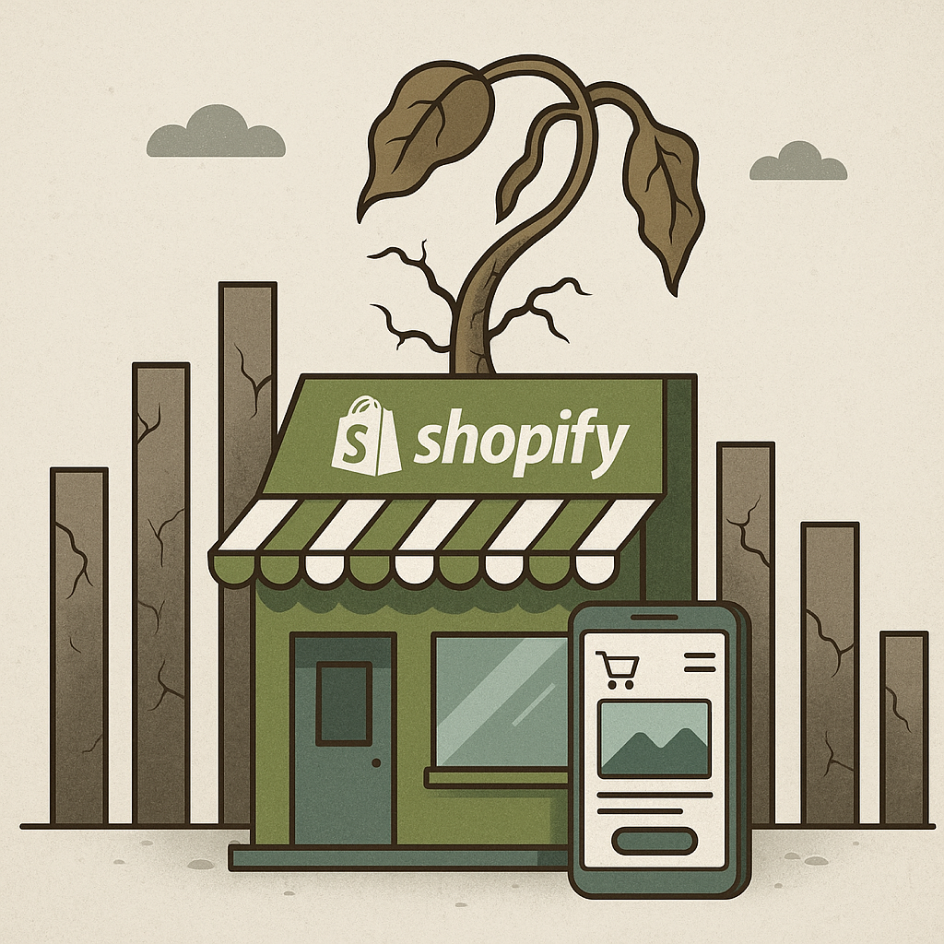
Past a certain point, growth gets incredibly hard and they feel stuck.
And the reason is simple: they’ve drained their tank and don’t want to fill it back up.
Let me explain.
The Client Who Kept Growing Until They Didn’t
This client was growing year after year — when this happened they were doing $20M/year online, but they were also spending a lot of money on marketing.
Almost 40% of their revenue went to ad spend.
And there came a point where the CFO stopped seeing what the CMO and their team did as a growth lever and started treating it as a cost center.
Right after that, they cut ad spend by 50% and decided to invest in optimizing what they already had: CRO, email and SMS marketing.
In other words, they shifted the focus from acquisition to retention.
The goal for the year became doing 10% more revenue than the year before, while spending 50% less, by improving what they already had.
It all seemed to make sense… Higher revenue, lower ad spend, and profits through the roof.
The first few months, hitting the targets was pretty easy. They doubled the number of emails and SMS being sent, and a couple of CRO experiments had a big impact.
But over time, these targets got harder and harder, until they became impossible.
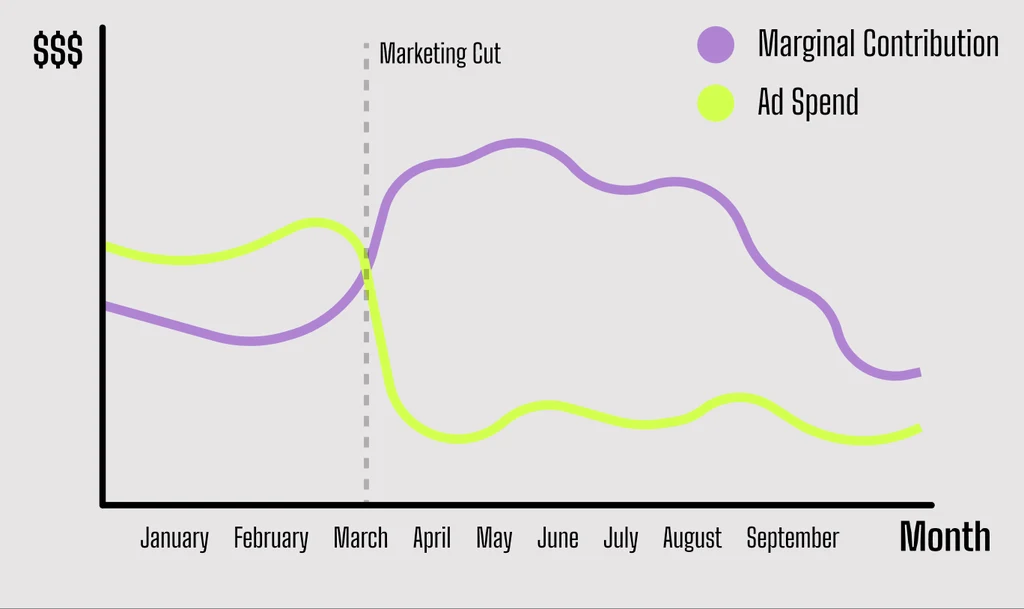
No matter how many new automations they built or how many winning experiments they shipped, the CMO couldn’t hit the targets.
And all of this because the CFO decided to floor the gas pedal and drained the eCommerce’s tank until it couldn’t go any further.
The Tank Analogy in eCommerce
In a previous post about eCommerce forecasting, I explained that your business is made up of two parts:
- New Customers: depend on how much you spend on ads and your organic base
- Recurring Customers: predictable and stable
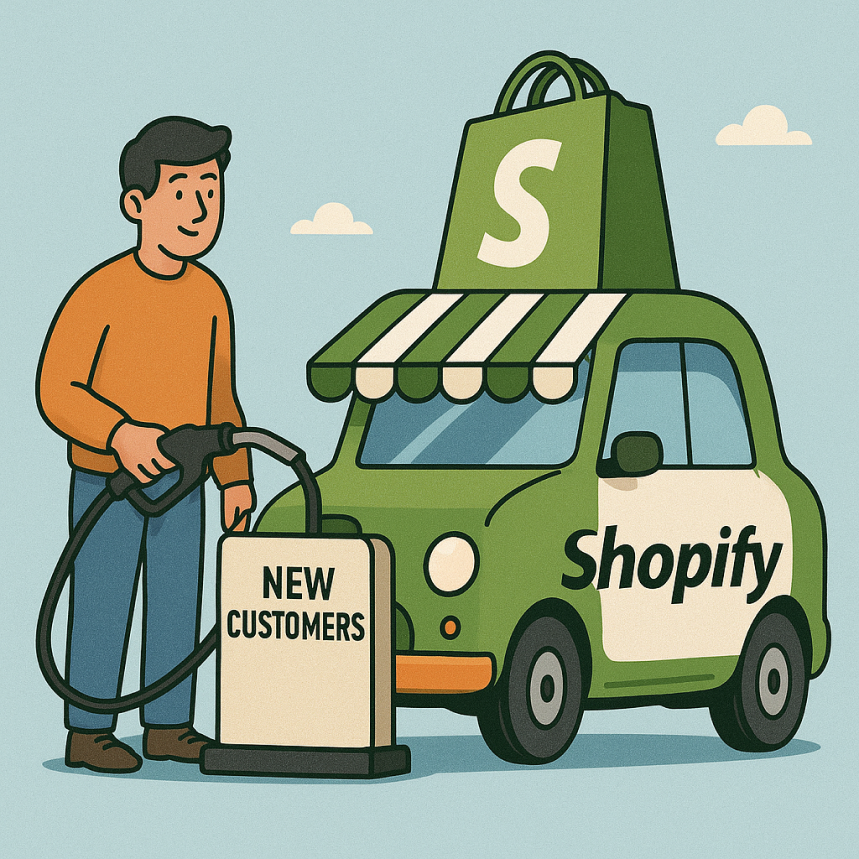
In that post, I used a tree to describe the business, but today we’re going to use a different analogy. A car, where recurring customers are the fuel tank.

As we all know, for the car to run properly, it needs a full tank.
For that, we have to pull over regularly to refuel. If we don’t, at some point the car will stop running.
If we want to get somewhere nearby faster, we can floor the gas pedal and burn more fuel.
But if we’re going on a long trip, at some point we’ll have to stop and fill up the tank.
And the same thing happens in eCommerce.
If what we want is to increase Marginal Contribution in the short term, we can cut ad spend (not refueling) and double the number of emails and SMS we send (flooring the gas pedal).
The result is predictable: the tank empties faster and we won’t be able to reach the destinations that are farther away (medium- and long-term growth).
Now, if what we want is to generate profit in the medium and long term too, at some point we’ll have to stop and refuel. In other words, we’ll have to start investing money in acquiring new customers again.
And very often, that decision comes too late.
The Solution Isn’t That Easy

At this point, increasing Marginal Contribution in the short term looks easy. You cut ad spend and squeeze recurring customers with emails, SMS and promotions.
But doing this has long-term consequences.
The recurring customers we have today exist thanks to past marketing investment. If we reduce or cut that investment in the present, there won’t be enough recurring customers to generate the Marginal Contribution we need in the future.
The solution seems simple… Let’s just ramp ad spend back up to make up for the lack of recurring customers, right?
In many cases, that’s impossible. Increasing marketing spend that much and that suddenly drives up acquisition costs, to the point where we lose money acquiring new customers.
In other words, the eCommerce can’t bring in that many new customers in such a short time without losing profitability.
The only option left is to lower growth expectations, increase the acquisition budget, and rebuild that base of recurring customers, little by little.
Some of you might run to your Shopify reports and say “but the number of recurring customers keeps going up.”
But we shouldn’t confuse the number of recurring customers with the revenue they generate each month.
To understand why this happens, we need to dig into what they’re made of.
Not All Recurring Customers Are the Same
Here’s the mistake most eCommerce brands make:
Thinking all recurring customers are the same.
A customer who bought from you 2 months ago isn’t worth the same as one who bought 12 or 18 months ago. Most likely, someone who hasn’t bought in a year won’t ever buy again, unlike someone who just went through your Checkout.
We can see this clearly in Shopify’s Cohort report.
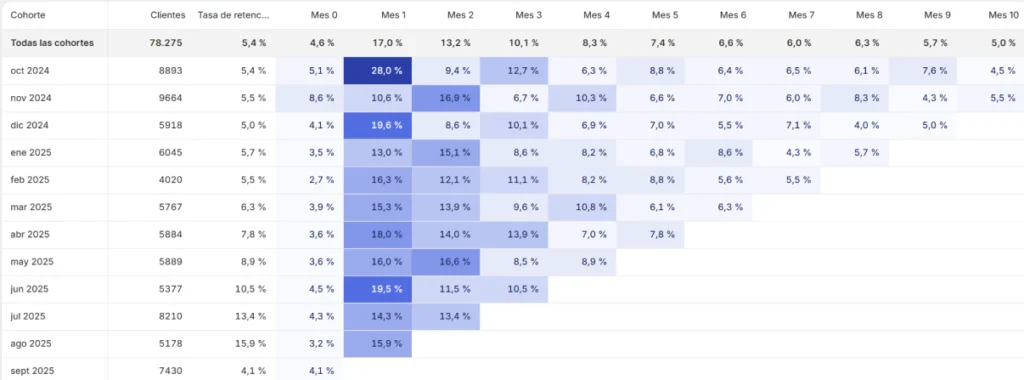
As you can see, the retention rate is much higher in the months closest to the first purchase and, the further out we go, the lower that percentage gets.
Even though we can’t see it in these reports, at the individual level the retention rate increases significantly when someone makes a 2nd or 3rd purchase.
In other words, the chance of a 3rd purchase goes up if they made the second one.
That’s why a good way to segment our recurring customers — and predict the revenue they’ll generate — is by time since last purchase.
And based on this metric, we can define 3 groups:
The 3 Types of Recurring Customers
At ASTEROI, we segment Recurring Customers into 3 types:
-
Active Recurring: Customers who bought from us recently
-
At-Risk Recurring: Customers who bought from us a while ago, but not so long ago that they’d be considered lost
-
Dormant Recurring: Customers who haven’t bought from us in a long time and probably won’t buy again.
It’s important to understand that the cutoffs depend on how each eCommerce behaves. A customer who hasn’t bought in 100 days from a jewelry store can be considered Active Recurring, while at a supplements store they’re a Lost Customer.
That’s why it’s important to do your own analysis and make decisions with your own data.
With these groups, we can define the real fuel of your eCommerce: Awake Customers.
Awake Customers: The Real Fuel
What really tells us our eCommerce’s ability to generate revenue isn’t just the total number of recurring customers we have (that number always goes up), but how many of them are actually “awake” and ready to buy.
With the segmentation we just built, we can calculate the number of “Awake” Customers we have each month and how it’s trending:
Awake Customers = New Customers Acquired + Active Recurring + At-Risk Recurring - Dormant Recurring
This metric tells us how many customers have a high probability of buying from us again, and therefore, it’s a good signal of our eCommerce’s ability to generate revenue from recurring customers.
And the best part is that we can watch how the number of Awake Customers evolves over the months and see whether we’re shrinking or growing it.
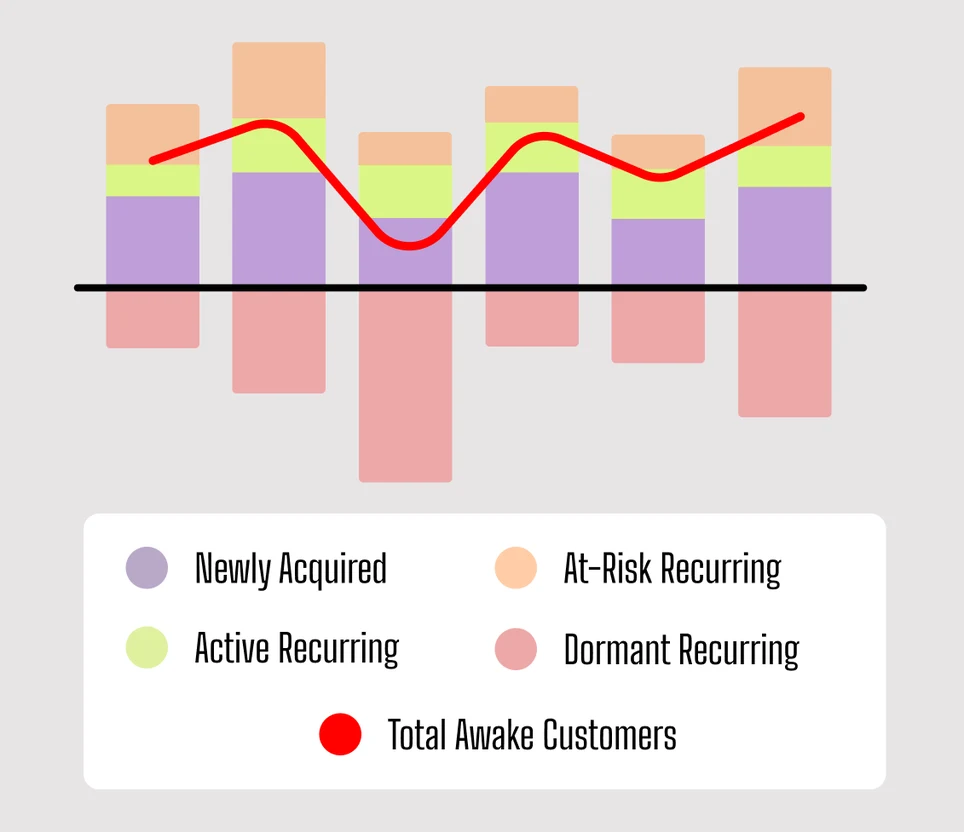
Now we can actually make decisions and build effective strategies.
For example, if we want to grow and have part of the revenue come from recurring customers, we need to invest in ads to increase the number of Awake Customers.
If we want to optimize Marginal Contribution in the short term by cutting marketing spend, we’ll know that will hurt our ability to generate revenue from recurring customers, and we should lower our expectations for future growth.
The End of the Story
Remember the client from the beginning? The one celebrating a 30% increase in Marginal Contribution…
By the time they hired us, months had already passed since they decided to cut ad spend and drain the fuel tank.
The month before we came in, they were 15% below target, and that month they were projecting -20%.
The first thing we did was understand what was going on and diagnose the problem.
Right after that, we sat down with the CMO and the CFO to explain that they had cut their number of Awake Customers in half and couldn’t increase ad spend without losing profitability.
Luckily, they both got it fast. Very often, optimizing for short-term profit comes at the cost of long-term growth.
To turn things around, we decided to build a new forecast with more realistic expectations and increase ad spend, little by little, always protecting profitability.
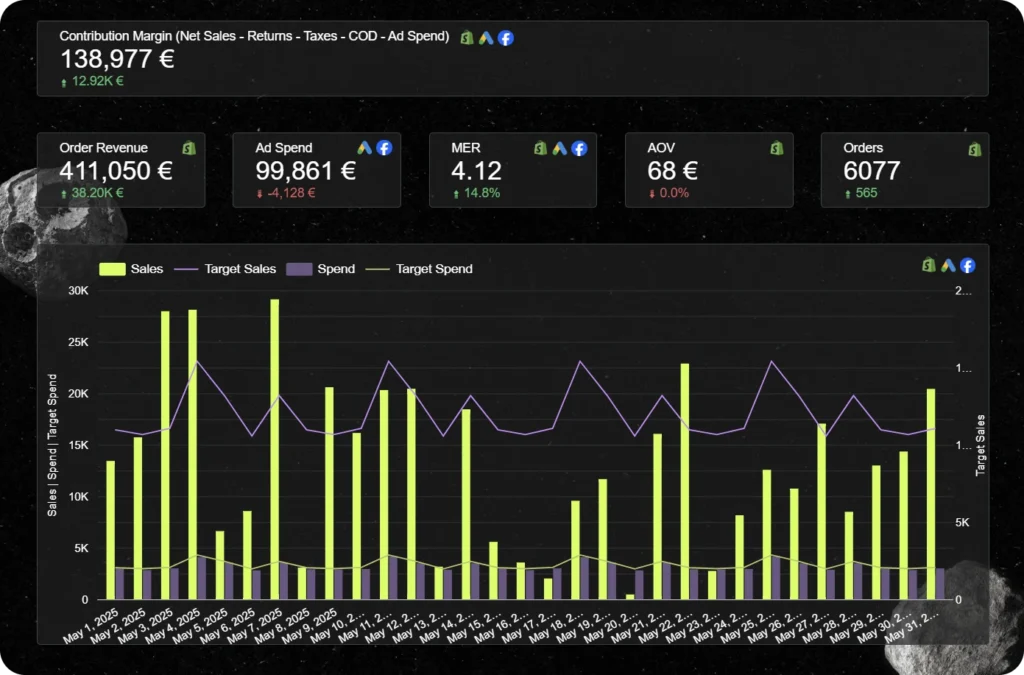
We also built a promo calendar to cover their short-term cash needs and developed dozens of new ads to power campaigns on Meta, Google and TikTok.
After 6 months, they had hit every target we’d set and were on track to beat even the targets they’d had before we came in.
The Lesson
This case perfectly illustrates that eCommerce strategy has to be approached from a perspective that brings together the short and the long term.
Otherwise, we risk losing market share, seeing revenue drop, and not being able to cover our costs.
If you need help understanding where your eCommerce stands, building the right strategy, and developing a forecast that ties all of the above together, let’s talk.
At ASTEROI we specialize in scaling 7-figure-plus eCommerce brands profitably through finance-driven marketing, strategy, and experimentation.
And yours could be one of them.